
 我要评论
我要评论1 动态sql
1.1 引言
mybatis令人喜欢的一大特性就是动态sql。 在使用jdbc的过程中, 根据条件进行sql的拼接是很麻烦且很容易出错的。mybatis动态sql的出现, 解决了这个麻烦。mybatis通过ognl来进行动态sql的使用的。
目前, 动态 sql 支持以下几种标签
| 元素 | 作用 | 备注 |
|---|---|---|
| if | 判断语句 | 单条件分支 |
| choose(when、otherwise) | 相当于 java 中的 if else | 多条件分支 |
| trim(where、set) | 辅助元素 | 用于处理 sql 拼接问题 |
| foreach | 循环语句 | 批量插入, 更新, 查询时经常用到 |
| bind | 创建一个变量, 并绑定到上下文中 | 用于兼容不同的数据库, 防止 sql 注入等 |
1.2 数据准备
为了后面的演示, 创建了一个maven项目 mybatis-dynamic, 创建了对应的数据库和表
drop table if exists `student`;
create table `student` (
  `student_id` int(10) unsigned not null auto_increment comment '编号',
  `name` varchar(20) default null comment '姓名',
  `phone` varchar(20) default null comment '电话',
  `email` varchar(50) default null comment '邮箱',
  `sex` tinyint(4) default null comment '性别',
  `locked` tinyint(4) default null comment '状态(0:正常,1:锁定)',
  `create_time` datetime default current_timestamp comment '存入数据库的时间',
  `update_time` datetime default current_timestamp on update current_timestamp comment '修改的时间',
  `delete` int(11) default null,
  primary key (`student_id`)
) engine=innodb auto_increment=7 default charset=utf8mb4 collate=utf8mb4_0900_ai_ci comment='学生表';
对应的项目结构
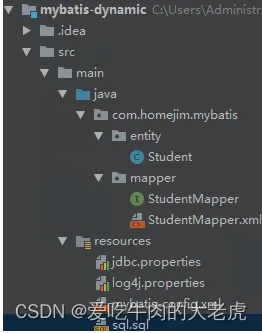
1.3 if 标签
if 标签是我们最常使用的。在查询、删除、更新的时候很可能会使用到。必须结合test属性联合使用
1.3.1 在 where 条件中使用 if 标签
这是常见的一种现象, 我们在进行按条件查询的时候, 可能会有多种情况。
查询条件
根据输入的学生信息进行条件检索
- 当只输入用户名时, 使用用户名进行模糊检索;
- 当只输入性别时, 使用性别进行完全匹配
- 当用户名和性别都存在时, 用这两个条件进行查询匹配查询
动态sql
<select id="selectbystudentselective" resultmap="baseresultmap" parametertype="com.homejim.mybatis.entity.student">
    select
    <include refid="base_column_list" />
    from student
    where 1=1
    <if test="name != null and name !=''">
      and name like concat('%', #{name}, '%')
    </if>
    <if test="sex != null">
      and sex=#{sex}
    </if>
  </select>
在此 sql 语句中, where 1=1 是多条件拼接时的小技巧, 后面的条件查询就可以都用 and 了。
同时, 我们添加了 if 标签来处理动态 sql
<if test="name != null and name !=''">
      and name like concat('%', #{name}, '%')
    </if>
    <if test="sex != null">
      and sex=#{sex}
    </if>
此 if 标签的test属性值是一个符合ognl的表达式, 表达式可以是true或false。如果表达式返回的是数值, 则0为false,非 0为true
1.3.2 在 update 更新列中使用 if 标签
有时候我们不希望更新所有的字段, 只更新有变化的字段。
示例sql
<update id="updatebyprimarykeyselective" parametertype="com.homejim.mybatis.entity.student">
    update student
    <set>
      <if test="name != null">
        `name` = #{name,jdbctype=varchar},
      </if>
      <if test="phone != null">
        phone = #{phone,jdbctype=varchar},
      </if>
      <if test="email != null">
        email = #{email,jdbctype=varchar},
      </if>
      <if test="sex != null">
        sex = #{sex,jdbctype=tinyint},
      </if>
      <if test="locked != null">
        locked = #{locked,jdbctype=tinyint},
      </if>
      <if test="createtime != null">
        create_time= #{createtime ,jdbctype=timestamp},
      </if>
      <if test="updatetime != null">
        update_time = #{updatetime ,jdbctype=timestamp},
      </if>
    </set>
    where student_id = #{studentid,jdbctype=integer}
1.3.3 在 insert 动态插入中使用 if 标签
我们插入数据库中的一条记录, 不是每一个字段都有值的, 而是动态变化的。在这时候使用 if 标签, 可帮我们解决这个问题。
如果只有非空属性才插入则对应的sql
<insert id="insertselective" parametertype="com.homejim.mybatis.entity.student">
    insert into student
    <trim prefix="(" suffix=")" suffixoverrides=",">
      <if test="studentid != null">
        student_id,
      </if>
      <if test="name != null">
        `name`,
      </if>
      <if test="phone != null">
        phone,
      </if>
      <if test="email != null">
        email,
      </if>
      <if test="sex != null">
        sex,
      </if>
      <if test="locked != null">
        locked,
      </if>
      <if test="createtime!= null">
        create_time,
      </if>
      <if test="updatetime != null">
        update_time,
      </if>
    </trim>
    <trim prefix="values (" suffix=")" suffixoverrides=",">
      <if test="studentid != null">
        #{studentid,jdbctype=integer},
      </if>
      <if test="name != null">
        #{name,jdbctype=varchar},
      </if>
      <if test="phone != null">
        #{phone,jdbctype=varchar},
      </if>
      <if test="email != null">
        #{email,jdbctype=varchar},
      </if>
      <if test="sex != null">
        #{sex,jdbctype=tinyint},
      </if>
      <if test="locked != null">
        #{locked,jdbctype=tinyint},
      </if>
      <if test="createtime != null">
        #{createtime,jdbctype=timestamp},
      </if>
      <if test="updatetime != null">
        #{updatetime,jdbctype=timestamp},
      </if>
    </trim>
  </insert>
1.4 choose 标签
choose when otherwise标签可以帮我们实现if else的逻辑。
一个choose标签至少有一个when, 最多一个otherwise
假如查询条件:
- 假设 name 具有唯一性, 查询一个学生
- 当 studen_id 有值时, 使用 studen_id 进行查询;
- 当 studen_id 没有值时, 使用 name 进行查询;
- 否则返回空
动态sql
<select id="selectbyidorname" resultmap="baseresultmap" parametertype="com.homejim.mybatis.entity.student">
    select
    <include refid="base_column_list" />
    from student
    where 1=1
    <choose>
      <when test="studentid != null">
        and student_id=#{studentid}
      </when>
      <when test="name != null and name != ''">
        and name=#{name}
      </when>
      <otherwise>
        and 1=2
      </otherwise>
    </choose>
  </select>
1.5 trim(set、where)
这三个其实解决的是类似的问题。如我们在写前面的[在where条件中使用if 标签 sql的时候, where 1=1 这个条件我们是不希望存在的。
1.5.1 where
查询条件:
- 根据输入的学生信息进行条件检索
- 当只输入用户名时, 使用用户名进行模糊检索;
- 当只输入性别时, 使用性别进行完全匹配
- 当用户名和性别都存在时, 用这两个条件进行查询匹配查询
不使用 where 1=1
动态 sql
 <select id="selectbystudentselectivewheretag" resultmap="baseresultmap" parametertype="com.homejim.mybatis.entity.student">
    select
    <include refid="base_column_list" />
    from student
   <where>
    <if test="name != null and name !=''">
      and name like concat('%', #{name}, '%')
    </if>
    <if test="sex != null">
      and sex=#{sex}
    </if>
   </where>
  </select>
1.5.2 set
set标签也类似, 在update更新列中使用if 标签中, 如果我们的方法 updatebyprimarykeyselective 没有使用 标签, 那么我们就要想办法处理字段全为空的条件, 字段不为空的条件等。有了这个, 我们只需要写 if 标签即可, 不需要处理类似的问题。
1.5.3 trim
set和where其实都是trim标签的一种类型, 该两种功能都可以使用trim标签进行实现。
1.5.3.1 trim 来表示 where
如where标签, 我们也可以写成
<trim prefix="where" prefixoverrides="and |or">
</trim>
表示当trim中含有内容时, 添加where, 且第一个为and或or时, 会将其去掉。而如果没有内容, 则不添加where。
1.5.3.2 trim 来表示 set
相应的,set标签可以如下表示
<trim prefix="set" suffixoverrides=",">
</trim>
表示当trim中含有内容时, 添加set, 且最后的内容为,时, 会将其去掉。而没有内容, 不添加 set
1.5.3.3 trim 的几个属性
prefix:当trim元素包含有内容时, 增加prefix所指定的前缀prefixoverrides:当trim元素包含有内容时, 去除prefixoverrides指定的 前缀
suffix:当trim元素包含有内容时, 增加suffix所指定的后缀suffixoverrides:当trim元素包含有内容时, 去除suffixoverrides指定的后缀
1.6 foreach 标签
foreach标签可以对数组,map或实现iterable接口。foreach中有以下几个属性:
collection:必填,集合/数组/map的名称item:变量名。即从迭代的对象中取出的每一个值index:索引的属性名。当迭代的对象为 map 时, 该值为 map 中的 keyopen:循环开头的字符串close:循环结束的字符串separator:每次循环的分隔符
其他的比较好理解, collection 中的值应该怎么设定呢?
跟接口方法中的参数相关。只有一个数组参数或集合参数默认情况:集合collection=list, 数组是collection=array
使用@param来指定参数的名称, 如我们在参数前@param("ids"), 则就填写collection=ids如果参数是map,指定为map中的对应的key即可。其实上面的 @param 最后也是转化为 map 的。
如果参数是对象使用属性.属性即可。
1.6.1 在 where 中使用 foreach
在 where条件中使用, 如按id集合查询, 按id集合删除等。
查询条件,我们希望查询用户 id 集合中的所有用户信息。
对应 sql
<select id="selectbystudentidlist" resultmap="baseresultmap">
    select
    <include refid="base_column_list" />
    from student
    where student_id in
    <foreach collection="list" item="id" open="(" close=")" separator="," index="i">
      #{id}
    </foreach>
  </select>
1.6.2 foreach 实现批量插入
可以通过foreach来实现批量插入
动态sql
 <insert id="insertlist">
    insert into student(name, phone, email, sex, locked)
    values
    <foreach collection="list" item="student" separator=",">
      (
      #{student.name}, #{student.phone},#{student.email},
      #{student.sex},#{student.locked}
      )
    </foreach>
  </insert>
1.7 bind 标签
bind标签是通过ognl表达式去定义一个上下文的变量, 这样方便我们使用。
如在selectbystudentselective方法中, 有如下
<if test="name != null and name !=''">
      and name like concat('%', #{name}, '%')
</if>
在 mysql 中, 该函数支持多参数, 但在 oracle 中只支持两个参数。那么我们可以使用 bind 来让该 sql 达到支持两个数据库的作用
<if test="name != null and name !=''">
     <bind name="namelike" value="'%'+name+'%'"/>
     and name like #{namelike}
</if>
到此这篇关于mybatis之动态sql使用讲解的文章就介绍到这了,更多相关mybatis动态sql内容请搜索代码网以前的文章或继续浏览下面的相关文章希望大家以后多多支持代码网!


发表评论