
 我要评论
我要评论因数据库中存的都是数字(数据字典),但是又没有数据字典表,只有后端知道是什么意思,查询返回给前端时,需要if-else进行转换成具体的值,很麻烦,现增加数据字典表,通过redis获取,转换成具体的值
1.建表
create table `data_dictionary`  (
  `id` bigint(20) not null comment '主键id',
  `module` varchar(255) character set utf8 collate utf8_general_ci not null default '' comment '归属模块',
  `name` varchar(255) character set utf8 collate utf8_general_ci not null default '' comment '字典名',
  `code` varchar(255) character set utf8 collate utf8_general_ci not null default '' comment '字典编码',
  `value` varchar(255) character set utf8 collate utf8_general_ci not null default '' comment '字典取值',
  `order` int(3) not null default -1 comment '排序',
  `state` tinyint(1) not null default -1 comment '启用状态 0:停用 1:启用',
  `create_time` datetime(0) null default null comment '创建时间',
  primary key (`id`)
)engine = innodb character set = utf8 collate = utf8_general_ci comment = '数据字典表';
2.mybatisplus生成controller,service,mapper,do等
下面是用到的do,vo
@data
@tablename("data_dictionary")
@apimodel(value="datadictionarydo对象", description="数据字典表")
public class datadictionarydo implements serializable {

    private static final long serialversionuid = 1l;

    @apimodelproperty(value = "主键id")
    @tableid(value = "id", type = idtype.assign_id)
    private long id;

    @apimodelproperty(value = "归属模块")
    private string module;

    @apimodelproperty(value = "字典名")
    private string name;

    @apimodelproperty(value = "字典编码")
    private string code;

    @apimodelproperty(value = "字典取值")
    private string value;

    @apimodelproperty(value = "排序")
    private integer sort;

    @apimodelproperty(value = "启用状态 0:停用 1:启用")
    private integer state;

    @apimodelproperty(value = "创建时间")
    @tablefield(value = "create_time", fill = fieldfill.insert)
    private date createtime;

}

@data
@apimodel(value = "datedictionaryvo对象", description = "数据字典vo")
@tostring
public class datadictionaryvo implements serializable {

    private static final long serialversionuid = 1l;

    @apimodelproperty(value = "字典编码")
    private string code;

    @apimodelproperty(value = "字典取值")
    private string value;

    @apimodelproperty(value = "redis key")
    private string key;

}
3.数据字典常量
/**
 * @description:数据字典常量
 */
public class datadictionaryconstant {

    /**
     * redis中数据字典key
     */
    public static final string data_dictionary_key = "datadictionary";

    /**
     * 合同-执行状态
     */
    public static final string contract_status = "contract:status";
}
4.redis配置
@configuration
public class redisconfig {

    @bean
    public redistemplate<string, object> redistemplate(redisconnectionfactory connectionfactory) {
        // 创建redistemplate对象
        redistemplate<string, object> template = new redistemplate<>();
        // 设置连接工厂
        template.setconnectionfactory(connectionfactory);
        // 创建json序列化工具
        genericjackson2jsonredisserializer jsonredisserializer = new genericjackson2jsonredisserializer();
        // 设置key的序列化
        template.setkeyserializer(redisserializer.string());
        template.sethashkeyserializer(redisserializer.string());
        // 设置value的序列化
        template.setvalueserializer(jsonredisserializer);
        template.sethashvalueserializer(jsonredisserializer);
        // 返回
        return template;
    }
}
5.实现springboot启动查询数据字典表
将数据缓存到redis中,使用@postconstruct注解
/**
 * @description:项目启动初始化数据字典到redis
 */
@slf4j
@component
public class initconfig {

    @autowired
    private datadictionarymapper  datadictionarymapper;
    @autowired
    redistemplate<string, object> redistemplate;

    @postconstruct
    public void initdatadictionary() {
        log.info("初始数据字典信息-开始");
        if (boolean.true.equals(redistemplate.haskey(data_dictionary_key))) {
            redistemplate.delete(data_dictionary_key);
        }
        list<datadictionarydo> dictionarydolist = datadictionarymapper.selectlist(null);
        map<string, list<datadictionaryvo>> datamap = dictionarydolist.stream().map(obj -> {
            datadictionaryvo datadictionaryvo = new datadictionaryvo();
            datadictionaryvo.setcode(obj.getcode());
            datadictionaryvo.setvalue(obj.getvalue());
            datadictionaryvo.setkey(obj.getmodule() + ":" + obj.getname());
            return datadictionaryvo;
        }).collect(collectors.groupingby(datadictionaryvo::getkey));
        redistemplate.opsforhash().putall(data_dictionary_key, datamap);
        log.info("初始数据字典信息-结束");
    }
}
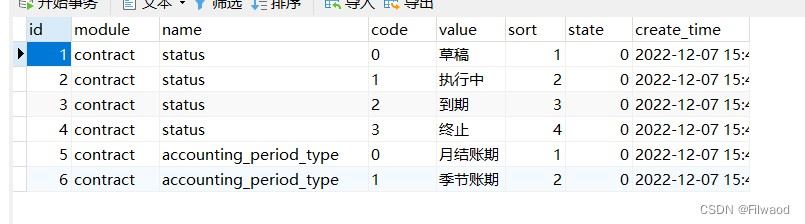
6.往表中插入几条数据
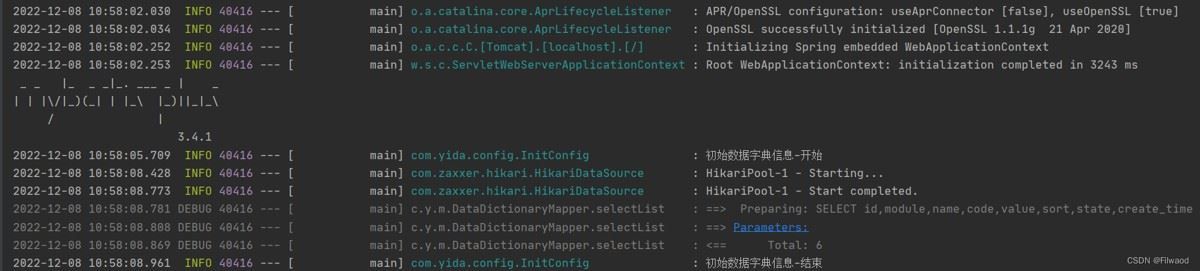
再启动项目,看效果
7.redis中查看
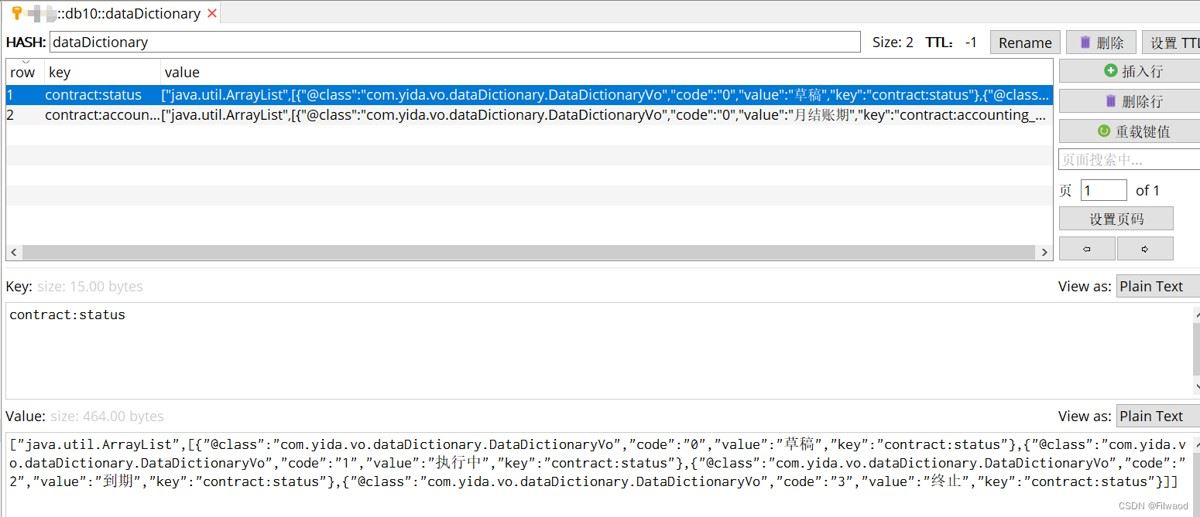
可以看到redis在序列化对象时,把类信息(@class)也序列化进来了,这样存的作用是反序列化时知道反序列化成什么对象,但是浪费了内存空间;不想存类信息的话,需要手动序列化成字符串再存进来,获取时再手动反序列成对象,看你怎么选择了
8.将获取封装成一个工具方法
方便调用
@service
public class redisservice {
    @autowired
    private redistemplate redistemplate;

    /**
     * 缓存中查数据字典
     * @param key redis key
     * @param code  字典编码
     * @return
     */
    public string getdatadictionary(string key, string code) {
        string value = null;
        if (boolean.true.equals(redistemplate.haskey(data_dictionary_key))) {
            list<datadictionaryvo> datadictionary = (list<datadictionaryvo>) redistemplate
                .opsforhash().get(data_dictionary_key, key);
            if (datadictionary.size() > 0) {
                value = datadictionary.stream().filter(obj -> code.equals(obj.getcode()))
                    .findfirst().get().getvalue();
            }
        }
        return value != null ? value : "";
    }

}
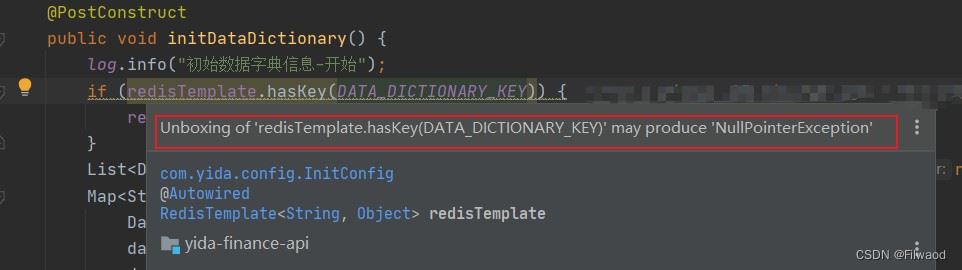
为什么要这么写
boolean.true.equals(redistemplate.haskey(key))
而不是
redistemplate.haskey(data_dictionary_key)
这是因为idea提示可能会出现空指针,然后查资料修改成上面的写法:https://www.jb51.net/program/36014522y.htm
9.使用
//使用
string value = redisservice.getdatadictionary(contract_status, "0");
system.out.println(value);
总结
以上为个人经验,希望能给大家一个参考,也希望大家多多支持代码网。



发表评论