
 我要评论
我要评论前情提要:本篇博客将详细介绍oracle的sql中的常用聚合函数(sum avg max min count)和分组(group by)及分组限制(having)的子句、语法、功能和示例详解
oracle版本:19c
一、聚合函数
聚合函数对行进行操作,以使每个组一个结果。
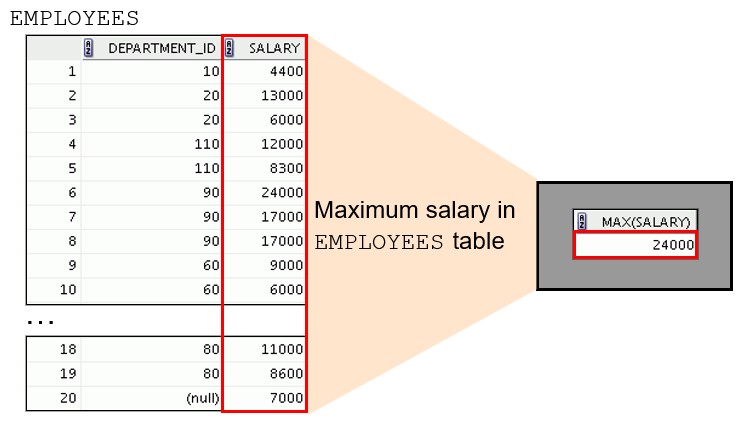
1.1 聚合函数的类型和语法
avg 平均值
count 求记录与数据个数
max 最大值
min 最小值
sum 求和
listagg 行转列函数
stddev 求标准差
variance 求协方差
median 求中位数
语法
select     group_function(column), ...
from	  table
[where	  condition];
1.2 聚合函数使用示例
avg, max, min, sum使用示例
可以使用avg和sum对数字进行运算
-- 计算平均工资,最高工资,最低工资,工资总和
sql> select avg(salary),max(salary),min(salary),sum(salary) from employees;

avg(salary) max(salary) min(salary) sum(salary)
----------- ----------- ----------- -----------
 6461.83178       24000        2100      691416
可以使用min和max在数字、字符与日期类型数据上
-- 计算最高工资
sql> select max(salary) from employees;

max(salary)
-----------
      24000

-- 计算最低工资
sql> select min(salary) from employees;

min(salary)
-----------
       2100

-- 判断日期
-- 判断日期标准:哪个日期离当前时间越近,就越大
-- 先修改日期格式方便查看
sql> alter session set nls_date_format='yyyy-mm-dd hh24:mi:ss';

session altered.

-- 查看最小日期和最大日期
sql> select min(hire_date),max(hire_date) from employees;

min(hire_date)      max(hire_date)
------------------- -------------------
2001-01-13 00:00:00 2008-04-21 00:00:00
count函数使用示例
count(*)或count(1)返回表中的行数
sql> select count(*) from employees;

  count(*)
----------
       107

sql> select count(1) from employees;
  count(1)
----------
       107
count(expr)返回expr具有非空值的行数
-- 表中原本有107行数据,但是count(commission_pct)却只统计出35行,是因为commission_pct中有空值,count不会统计空值
sql> select count(commission_pct) from employees;

count(commission_pct)
---------------------
                   35

-- 如果想统计所有的行,但是又存在空值,则可以使用nvl将空值进行转换
sql> select count(nvl(commission_pct,0)) from employees;

count(nvl(commission_pct,0))
----------------------------
                         107
使用distinct关键字
count(distinct expr)返回表达式中的不同非null值的数量。
在employees表中显示不同部门值的数量:
-- 如果不想统计重复值可以使用distinct去重
sql> select count(department_id),count(distinct department_id) from employees;

count(department_id) count(distinctdepartment_id)
-------------------- ----------------------------
                 106                           11
-- 不去重统计department_id有106行,去重后只有11行了
聚合函数和null值
忽略列中的null值
-- 使用avg计算commission_pct,但是由于commission_pct存在空值会被忽略,导致结果不准确
sql> select avg(commission_pct) from employees;
avg(commission_pct)
-------------------
         .222857143
使用nvl函数强制将列中的null值进行转换
sql> select avg(nvl(commission_pct,0)) from employees;

avg(nvl(commission_pct,0))
--------------------------
               .0728971963
二、分组
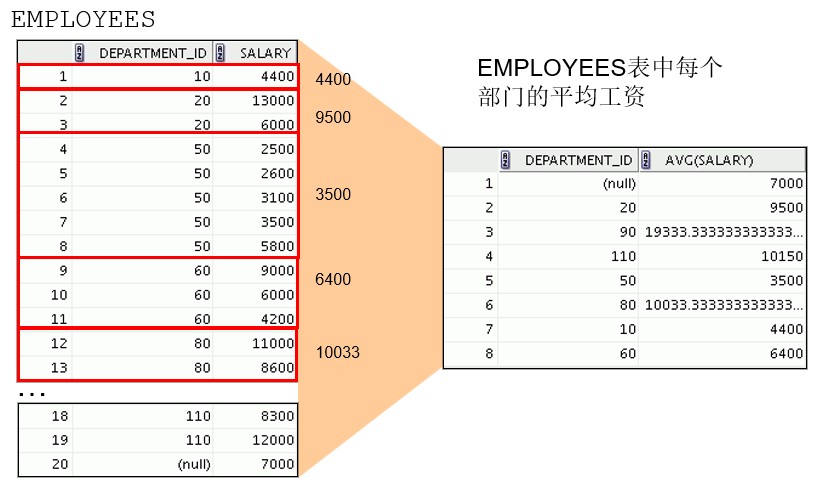
对数据进行分组
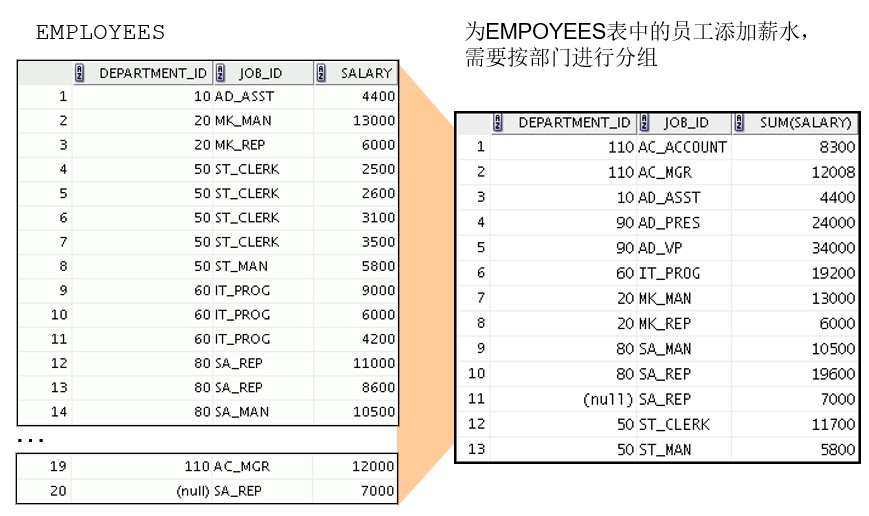
按多列分组
group by子句语法
select    column, group_function(column)
from      table
[where    condition]
[group by group_by_expression]
[order by column];
2.1 group by 子句
select列表中所有不在分组(聚合)函数中的列必须在group by子句中
group by列不必在select列表中
示例
按照department_id【部门编号】进行分组,分组以后求每个部门的平均工资
sql> select department_id, avg(salary) from employees group by department_id;	-- 先分组再聚合

department_id avg(salary)
------------- -----------
           50  3475.55556
           40        6500
          110       10154
           90  19333.3333
           30        4150
           70       10000
                     7000
           10        4400
           20        9500
           60        5760
          100  8601.33333

department_id avg(salary)
------------- -----------
           80  8955.88235

12 rows selected.
按照部门分组后再按照岗位分组,最后求不同部门的不同岗位的平均工资并且按照部门升序排序
sql> select department_id,job_id,sum(salary)
  2  from employees
  3  where department_id>40
  4  group by department_id,job_id
  5  order by department_id;

department_id job_id     sum(salary)
------------- ---------- -----------
           50 sh_clerk         64300
           50 st_clerk         55700
           50 st_man           36400
           60 it_prog          28800
           70 pr_rep           10000
           80 sa_man           61000
           80 sa_rep          243500
           90 ad_pres          24000
           90 ad_vp            34000
          100 fi_account       39600
          100 fi_mgr           12008

department_id job_id     sum(salary)
------------- ---------- -----------
          110 ac_account        8300
          110 ac_mgr           12008

13 rows selected.
求部门的平均工资
-- group by 列不必在select列表中
sql> select avg(salary)
  2  from employees
  3  group by department_id;

avg(salary)
-----------
 3475.55556
       6500
      10154
 19333.3333
       4150
      10000
       7000
       4400
       9500
       5760
 8601.33333

avg(salary)
-----------
 8955.88235

12 rows selected.

-- 但是select列中不在聚合函数中的列必须在group by列中
sql> select department_id,avg(salary)
  2  from employees
  3* group by department_id;
department_id avg(salary)
------------- -----------
           50  3475.55556
           40        6500
          110       10154
           90  19333.3333
           30        4150
           70       10000
                     7000
           10        4400
           20        9500
           60        5760
          100  8601.33333

department_id avg(salary)
------------- -----------
           80  8955.88235

12 rows selected.
2.2 使用聚合函数的非法查询
select列表中不是聚合函数的任何列或表达式都必须在group by子句中:
错误示例
sql> select department_id,count(last_name)
  2  from employees;
select department_id,count(last_name)
       *
error at line 1:
ora-00937: not a single-group group function
-- 必须添加group by子句以计算每个department_id的last_name。

sql> select department_id,job_id,count(last_name)
  2  from employees
  3  group by deepartment_id;
group by deepartment_id
         *
error at line 3:
ora-00904: "deepartment_id": invalid identifier
-- 在group by中添加job_id或从select列表中删除job_id列。
您不能使用where子句来限制组。
您可以使用having子句来限制组。
您不能在where子句中使用聚合函数。
错误示例
sql> select department_id,avg(salary)
  2  from employees
  3  where avg(salary) > 8000
  4  group by department_id;
where avg(salary) > 8000
      *
error at line 3:
ora-00934: group function is not allowed here
-- 不能使用where子句来限制分组
2.3 使用having子句限制分组结果集
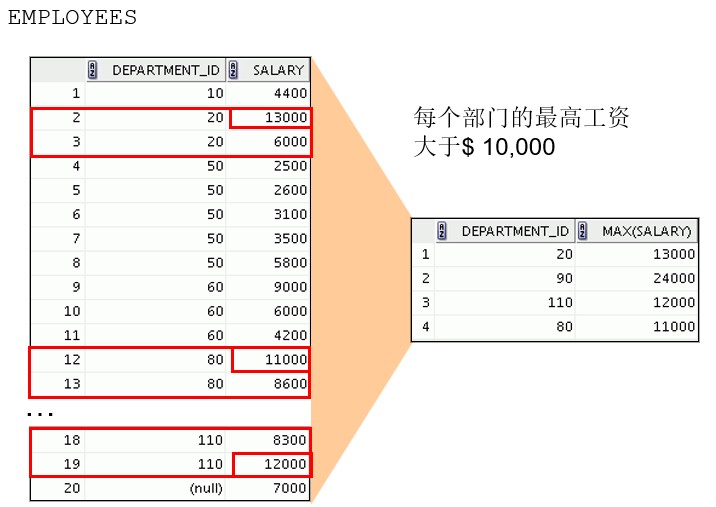
当您使用having子句时,oracle服务器对组的限制如下:
1.行被分组。
2.应用分组功能。
3.显示与having子句匹配的组。
使用having的限制
不能引用非分组列:having条件中不能使用未在group by中指定的列
不能使用别名:不能直接使用select子句中定义的别名,必须使用原始列名或聚合函数
不能包含子查询:having条件中不能嵌套子查询
语法
select    column, group_function
from      table
[where    condition]
[group by group_by_expression]
[having   group_condition]
[order by column];
使用having子句示例
查看平均工资大于8000的部门
sql> select department_id,avg(salary)
  2  from employees
  3  group by department_id
  4  having avg(salary)>8000;

department_id avg(salary)
------------- -----------
          110       10154
           90  19333.3333
           70       10000
           20        9500
          100  8601.33333
           80  8955.88235

6 rows selected.
查询工资总和大于13000且不含’rep‘字符的岗位,并且按照工资总和升序排序
sql> select job_id,sum(salary) payroll
  2  from employees
  3  where job_id not like '%rep%'
  4  group by job_id
  5  having sum(salary)>13000
  6  order by sum(salary);

job_id        payroll
---------- ----------
pu_clerk        13900
ad_pres         24000
it_prog         28800
ad_vp           34000
st_man          36400
fi_account      39600
st_clerk        55700
sa_man          61000
sh_clerk        64300

9 rows selected.
三、嵌套聚合函数
聚合函数可以嵌套使用
示例
显示最高平均工资
sql> select max(avg(salary))
  2  from employees
  3  group by department_id;

max(avg(salary))
----------------
      19333.3333
总结
以上为个人经验,希望能给大家一个参考,也希望大家多多支持代码网。



发表评论