
 我要评论
我要评论随着ai agent技术的兴起,java开发者也纷纷投身智能体开发。然而,许多新手在学习过程中容易陷入误区,导致学习效率低下甚至半途而废。本文将深入剖析3个最常见的误区,帮助你在java智能体学习路上少走弯路。
前言
java作为企业级应用的首选语言,在ai智能体开发领域也有其独特优势。然而,相比于python在ai领域的统治地位,java开发者学习智能体技术面临着更多的挑战和选择。本文将结合实际开发经验,为你揭示java智能体学习中的常见陷阱,并提供科学的学习路径。
误区一:过度依赖框架,忽视底层原理
1.1 误区表现
很多新手在学习java智能体时,直接上手使用langchain4j、spring ai等框架,却完全不理解agent的工作原理。这就像学习开车直接上高速,连油门刹车都不认识。
1.2 问题诊断流程
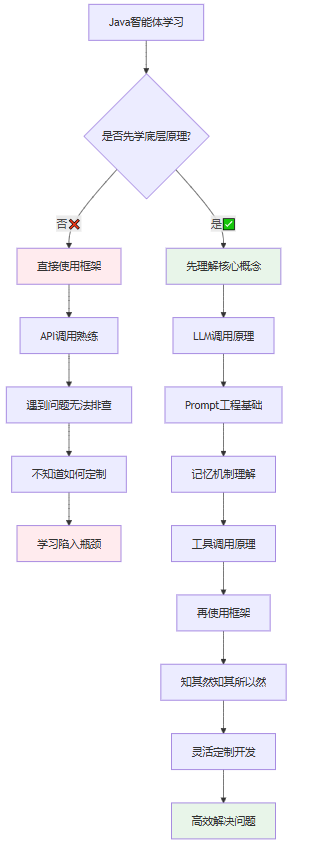
1.3 正确做法:从零构建理解
错误示范:直接使用框架
// 错误:直接使用langchain4j,不知其所以然
@service
public class badagentservice {

    @inject
    chatlanguagemodel model;

    public string chat(string message) {
        // 只会调用api,不理解背后的原理
        return model.generate(message);
        // 问题:prompt怎么优化?失败怎么办?成本如何控制?
    }
}
正确示范:先理解底层,再用框架
import com.fasterxml.jackson.databind.objectmapper;
import okhttp3.*;
import java.io.ioexception;
import java.util.*;

/**
 * llm客户端基础实现
 * 理解llm调用的核心原理后再使用框架
 */
public class llmclient {

    private static final string api_url = "https://api.openai.com/v1/chat/completions";
    private final string apikey;
    private final okhttpclient httpclient;
    private final objectmapper objectmapper;

    public llmclient(string apikey) {
        this.apikey = apikey;
        this.httpclient = new okhttpclient();
        this.objectmapper = new objectmapper();
    }

    /**
     * 基础聊天完成请求
     * 理解参数含义:temperature、max_tokens等
     */
    public string chat(string usermessage, string systemprompt) throws ioexception {
        // 构建请求体 - 理解消息格式
        map<string, object> requestbody = new hashmap<>();
        requestbody.put("model", "gpt-3.5-turbo");

        // 理解角色系统:system/user/assistant
        list<map<string, string>> messages = new arraylist<>();
        messages.add(map.of("role", "system", "content", systemprompt));
        messages.add(map.of("role", "user", "content", usermessage));
        requestbody.put("messages", messages);

        // 理解参数作用
        requestbody.put("temperature", 0.7);  // 控制随机性
        requestbody.put("max_tokens", 2000);  // 控制输出长度
        requestbody.put("top_p", 1.0);        // 核采样

        // 发送请求 - 理解http通信
        request request = new request.builder()
                .url(api_url)
                .addheader("authorization", "bearer " + apikey)
                .addheader("content-type", "application/json")
                .post(requestbody.create(
                        objectmapper.writevalueasstring(requestbody),
                        mediatype.parse("application/json")
                ))
                .build();

        try (response response = httpclient.newcall(request).execute()) {
            if (!response.issuccessful()) {
                throw new ioexception("api调用失败: " + response.code());
            }

            string responsebody = response.body().string();
            return parseresponse(responsebody);
        }
    }

    /**
     * 流式响应 - 理解server-sent events
     */
    public void chatstream(string usermessage, streamcallback callback) {
        // 流式请求实现
        // 理解sse协议和流式处理
    }

    private string parseresponse(string responsebody) throws ioexception {
        // 解析响应 - 理解返回格式
        map<string, object> response = objectmapper.readvalue(responsebody, map.class);
        list<map<string, object>> choices = (list<map<string, object>>) response.get("choices");
        map<string, object> message = (map<string, object>) choices.get(0).get("message");
        return (string) message.get("content");
    }

    @functionalinterface
    public interface streamcallback {
        void onchunk(string chunk);
    }
}
import java.util.*;

/**
 * 记忆管理基础实现
 * 理解agent的记忆机制
 */
public class memorymanager {

    // 对话历史
    private final list<map<string, string>> conversationhistory = new arraylist<>();

    // 长期记忆存储
    private final map<string, object> longtermmemory = new hashmap<>();

    // 记忆重要性评估
    private final int maxhistorysize = 50;

    /**
     * 添加消息到历史
     * 理解token限制和上下文窗口管理
     */
    public void addmessage(string role, string content) {
        map<string, string> message = map.of("role", role, "content", content);
        conversationhistory.add(message);

        // 管理历史长度 - 滑动窗口策略
        if (conversationhistory.size() > maxhistorysize) {
            // 保留最近的n条消息
            int removecount = conversationhistory.size() - maxhistorysize;
            for (int i = 0; i < removecount; i++) {
                conversationhistory.remove(0);
            }
        }
    }

    /**
     * 构建上下文 - 理解提示词工程
     */
    public list<map<string, string>> buildcontext(string systemprompt) {
        list<map<string, string>> context = new arraylist<>();

        // 系统提示词
        context.add(map.of("role", "system", "content", systemprompt));

        // 添加长期记忆中的关键信息
        string memorycontext = buildmemorycontext();
        if (!memorycontext.isempty()) {
            context.add(map.of("role", "system", "content",
                "重要背景信息:" + memorycontext));
        }

        // 对话历史
        context.addall(conversationhistory);

        return context;
    }

    /**
     * 记忆检索 - 理解向量检索原理
     */
    public list<string> retrieverelevantmemory(string query, int topk) {
        // 简化版:基于关键词匹配
        // 实际应该使用向量相似度检索

        list<string> relevant = new arraylist<>();
        // todo: 实现向量检索
        return relevant;
    }

    private string buildmemorycontext() {
        // 构建记忆摘要
        stringbuilder sb = new stringbuilder();
        longtermmemory.foreach((key, value) -> {
            sb.append(key).append(": ").append(value).append("; ");
        });
        return sb.tostring();
    }

    public void savetolongtermmemory(string key, object value) {
        longtermmemory.put(key, value);
    }
}
误区二:忽视java特性,照搬python方案
2.1 误区表现
很多教程和示例都是python写的,java开发者容易直接照搬,忽略了java的语言特性和生态差异。
2.2 常见错误对比
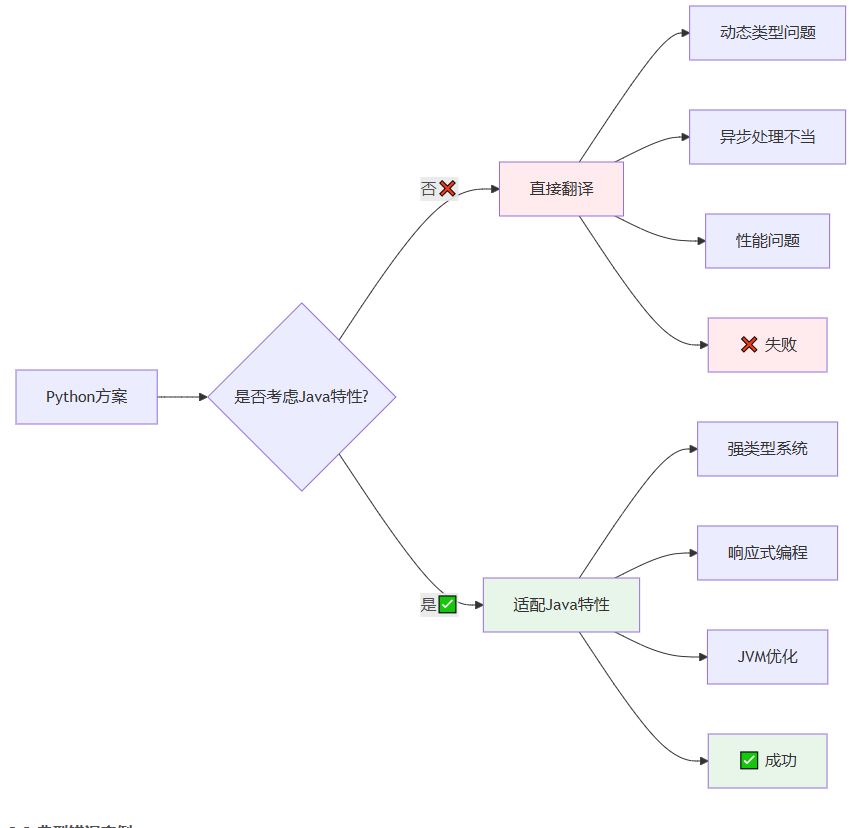
2.3 典型错误案例
错误1:字符串拼接json
// 错误:像python一样直接拼接字符串
public class badjsonhandler {

    public string buildprompt(string name, int age) {
        // python风格的字符串格式化
        return "你好 " + name + ",你今年 " + age + " 岁了";
        // 问题:没有类型安全,容易出错
    }

    public string parseresponse(string jsonstr) {
        // 手动解析json
        int start = jsonstr.indexof("\"content\": \"") + 11;
        int end = jsonstr.indexof("\"", start);
        return jsonstr.substring(start, end);
        // 问题:脆弱、易错、难以维护
    }
}
正确1:使用java类型系统
import com.fasterxml.jackson.annotation.jsonproperty;
import com.fasterxml.jackson.core.jsonprocessingexception;
import com.fasterxml.jackson.databind.objectmapper;
import lombok.builder;
import lombok.data;
import lombok.extern.slf4j.slf4j;

/**
 * java风格的类型安全实现
 */
@slf4j
public class goodjsonhandler {

    private final objectmapper objectmapper = new objectmapper();

    /**
     * 使用强类型对象
     */
    @data
    @builder
    public static class chatrequest {
        @jsonproperty("model")
        private string model;

        @jsonproperty("messages")
        private list<message> messages;

        @jsonproperty("temperature")
        private double temperature;

        @jsonproperty("max_tokens")
        private integer maxtokens;
    }

    @data
    @builder
    public static class message {
        @jsonproperty("role")
        private string role;

        @jsonproperty("content")
        private string content;
    }

    @data
    public static class chatresponse {
        @jsonproperty("id")
        private string id;

        @jsonproperty("choices")
        private list<choice> choices;

        @jsonproperty("usage")
        private usage usage;

        @data
        public static class choice {
            @jsonproperty("index")
            private integer index;

            @jsonproperty("message")
            private message message;

            @jsonproperty("finish_reason")
            private string finishreason;
        }

        @data
        public static class usage {
            @jsonproperty("prompt_tokens")
            private integer prompttokens;

            @jsonproperty("completion_tokens")
            private integer completiontokens;

            @jsonproperty("total_tokens")
            private integer totaltokens;
        }
    }

    /**
     * 使用record模式(java 16+)
     */
    public record userinfo(string name, int age) {}

    /**
     * 类型安全的prompt构建
     */
    public string buildprompt(userinfo user) {
        return string.format("你好 %s,你今年 %d 岁了", user.name(), user.age());
    }

    /**
     * 类型安全的json序列化
     */
    public string serializerequest(chatrequest request) {
        try {
            return objectmapper.writevalueasstring(request);
        } catch (jsonprocessingexception e) {
            log.error("json序列化失败", e);
            throw new runtimeexception("请求构建失败", e);
        }
    }

    /**
     * 类型安全的json反序列化
     */
    public chatresponse parseresponse(string jsonstr) {
        try {
            return objectmapper.readvalue(jsonstr, chatresponse.class);
        } catch (jsonprocessingexception e) {
            log.error("json反序列化失败: {}", jsonstr, e);
            throw new runtimeexception("响应解析失败", e);
        }
    }

    /**
     * 使用java的optional处理可能为空的值
     */
    public string safeextractcontent(chatresponse response) {
        return optional.ofnullable(response)
                .map(chatresponse::getchoices)
                .filter(choices -> !choices.isempty())
                .map(choices -> choices.get(0))
                .map(choice::getmessage)
                .map(message::getcontent)
                .orelse("无法获取响应内容");
    }
}
错误2:同步阻塞调用
// 错误:像python一样同步调用
public class badasynchandler {

    public void handlemultiplerequests(list<string> prompts) {
        for (string prompt : prompts) {
            // 同步调用,阻塞等待
            string response = callllm(prompt);
            system.out.println(response);
        }
        // 问题:性能差,无法利用java并发优势
    }

    private string callllm(string prompt) {
        // 同步http调用
        return "response";
    }
}
正确2:使用java响应式编程
import reactor.core.publisher.flux;
import reactor.core.publisher.mono;
import reactor.core.scheduler.schedulers;
import lombok.extern.slf4j.slf4j;
import java.util.list;

/**
 * java风格的响应式异步处理
 */
@slf4j
public class goodasynchandler {

    private final llmclient llmclient;

    public goodasynchandler(llmclient llmclient) {
        this.llmclient = llmclient;
    }

    /**
     * 使用project reactor处理并发请求
     */
    public flux<string> handlemultiplerequestsreactive(list<string> prompts) {
        return flux.fromiterable(prompts)
                .flatmap(prompt ->
                    mono.fromcallable(() -> llmclient.chat(prompt, "你是一个助手"))
                        .subscribeon(schedulers.boundedelastic())
                        .doonerror(e -> log.error("处理失败: {}", prompt, e))
                        .onerrorreturn("处理失败")
                )
                .doonnext(response -> log.info("收到响应"));
    }

    /**
     * 使用virtual thread(java 21+)
     */
    public void handlemultiplerequestsvirtualthreads(list<string> prompts) {
        try (var executor = executors.newvirtualthreadpertaskexecutor()) {
            list<future<string>> futures = prompts.stream()
                    .map(prompt -> executor.submit(() -> llmclient.chat(prompt, "你是一个助手")))
                    .tolist();

            for (future<string> future : futures) {
                try {
                    string response = future.get();
                    log.info("响应: {}", response);
                } catch (exception e) {
                    log.error("获取响应失败", e);
                }
            }
        }
    }

    /**
     * 使用completablefuture(java 8+)
     */
    public completablefuture<list<string>> handlemultiplerequestsasync(list<string> prompts) {
        list<completablefuture<string>> futures = prompts.stream()
                .map(prompt -> completablefuture.supplyasync(
                        () -> llmclient.chat(prompt, "你是一个助手"),
                        executors.newvirtualthreadpertaskexecutor()
                ).exceptionally(e -> {
                    log.error("请求失败: {}", prompt, e);
                    return "默认响应";
                }))
                .tolist();

        return completablefuture.allof(futures.toarray(new completablefuture[0]))
                .thenapply(v -> futures.stream()
                        .map(completablefuture::join)
                        .tolist());
    }

    /**
     * 带限流的并发控制
     */
    public flux<string> handlewithratelimit(list<string> prompts, int ratepersecond) {
        return flux.fromiterable(prompts)
                .delayelements(duration.ofmillis(1000 / ratepersecond))
                .flatmap(prompt ->
                    mono.fromcallable(() -> llmclient.chat(prompt, "助手"))
                        .timeout(duration.ofseconds(30))
                        .retry(2)
                        .onerrorreturn("超时")
                );
    }
}
2.4 java vs python agent开发对比
| 特性 | python | java |
|---|---|---|
| 类型系统 | 动态类型,灵活但易错 | 静态类型,安全但冗长 |
| 异步处理 | asyncio | reactor/rxjava/virtual thread |
| 生态丰富度 | ai库非常丰富 | 相对较少,但企业级强 |
| 性能 | 解释执行,较慢 | jvm优化,性能更好 |
| 部署 | 简单 | 稍复杂但更稳定 |
| 适用场景 | 快速原型、研究 | 生产环境、企业应用 |
误区三:重功能轻工程,缺乏生产思维
3.1 误区表现
很多开发者只关注agent"能不能用",忽略了生产环境必需的稳定性、可观测性、安全性等工程问题。
3.2 生产级agent要求
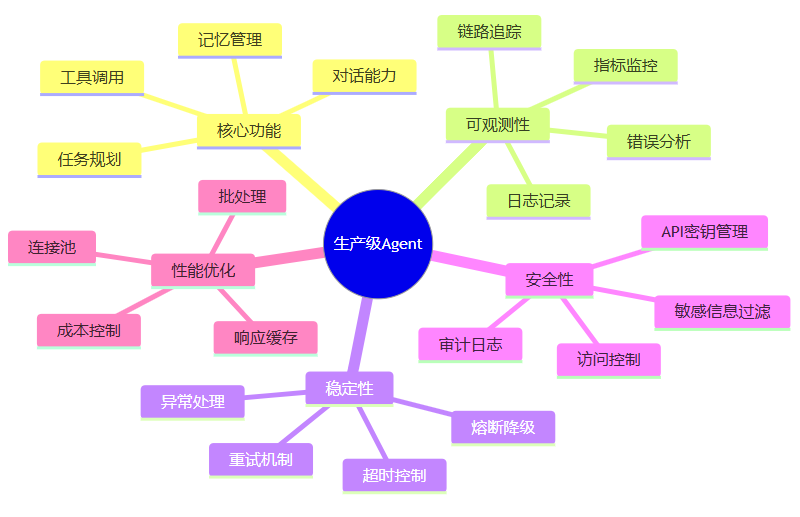
3.3 生产级agent实现
import io.micrometer.core.instrument.*;
import io.micrometer.core.instrument.binder.jvm.jvmmemorymetrics;
import io.micrometer.prometheus.prometheusconfig;
import io.micrometer.prometheus.prometheusmeterregistry;
import lombok.extern.slf4j.slf4j;
import org.springframework.retry.annotation.backoff;
import org.springframework.retry.annotation.retryable;
import org.springframework.stereotype.component;
import reactor.core.publisher.mono;
import java.time.duration;
import java.util.concurrent.*;

/**
 * 生产级agent实现
 * 包含监控、重试、限流、缓存等生产特性
 */
@slf4j
@component
public class productionagent {

    // 监控指标
    private final meterregistry meterregistry;
    private final counter requestcounter;
    private final counter errorcounter;
    private final timer responsetimer;
    private final gauge cachehitrate;

    // 限流器
    private final ratelimiter ratelimiter;

    // 缓存
    private final cache<string, string> responsecache;

    // 断路器
    private final circuitbreaker circuitbreaker;

    private final llmclient llmclient;

    public productionagent(llmclient llmclient) {
        this.llmclient = llmclient;

        // 初始化监控
        this.meterregistry = new prometheusmeterregistry(prometheusconfig.default);
        this.requestcounter = counter.builder("agent.requests.total")
                .description("总请求数")
                .register(meterregistry);
        this.errorcounter = counter.builder("agent.errors.total")
                .description("错误数")
                .register(meterregistry);
        this.responsetimer = timer.builder("agent.response.time")
                .description("响应时间")
                .publishpercentiles(0.5, 0.95, 0.99)
                .register(meterregistry);

        // 初始化限流
        this.ratelimiter = ratelimiter.create(10.0); // 每秒10个请求

        // 初始化缓存
        this.responsecache = caffeine.newbuilder()
                .maximumsize(1000)
                .expireafterwrite(duration.ofminutes(10))
                .recordstats()
                .build();

        this.cachehitrate = gauge.builder("agent.cache.hit.rate",
                responsecache, cache -> {
                    var stats = cache.stats();
                    return stats.hitcount() / (double) (stats.hitcount() + stats.misscount());
                })
                .register(meterregistry);

        // 初始化断路器
        this.circuitbreaker = circuitbreaker.ofdefaults("llm-service");
        circuitbreaker.geteventpublisher()
                .onstatetransition(event ->
                    log.info("断路器状态变更: {}", event));
    }

    /**
     * 生产级聊天方法
     * 包含完整的监控、限流、重试、缓存
     */
    @retryable(
        value = {llmexception.class},
        maxattempts = 3,
        backoff = @backoff(delay = 1000, multiplier = 2)
    )
    public mono<agentresponse> chat(agentrequest request) {
        requestcounter.increment();

        return mono.fromcallable(() -> {
            // 检查断路器
            if (!circuitbreaker.tryacquirepermission()) {
                throw new llmexception("服务暂时不可用,请稍后重试");
            }

            // 限流检查
            if (!ratelimiter.tryacquire(duration.ofseconds(5))) {
                throw new llmexception("请求过多,请稍后重试");
            }

            // 检查缓存
            string cachekey = buildcachekey(request);
            string cachedresponse = responsecache.getifpresent(cachekey);
            if (cachedresponse != null) {
                log.debug("缓存命中: {}", cachekey);
                return agentresponse.builder()
                        .content(cachedresponse)
                        .cached(true)
                        .build();
            }

            // 记录开始时间
            long starttime = system.nanotime();
            timer.sample sample = timer.start(meterregistry);

            try {
                // 调用llm
                string response = llmclient.chat(
                        request.getmessage(),
                        request.getsystemprompt()
                );

                // 成功时更新断路器
                circuitbreaker.onsuccess(0, timeunit.nanoseconds);

                // 缓存响应
                if (request.iscacheable()) {
                    responsecache.put(cachekey, response);
                }

                // 记录指标
                sample.stop(responsetimer);
                log.info("请求成功,耗时: {}ms",
                        timeunit.nanoseconds.tomillis(system.nanotime() - starttime));

                return agentresponse.builder()
                        .content(response)
                        .cached(false)
                        .tokens(estimatetokens(request.getmessage(), response))
                        .build();

            } catch (exception e) {
                // 失败时记录断路器
                circuitbreaker.onerror(0, timeunit.nanoseconds, e);
                errorcounter.increment();
                log.error("llm调用失败", e);
                throw new llmexception("llm调用失败", e);
            }

        }).subscribeon(schedulers.boundedelastic());
    }

    /**
     * 批量处理优化
     */
    public flux<agentresponse> chatbatch(list<agentrequest> requests) {
        return flux.fromiterable(requests)
                .flatmap(request -> chat(request)
                        .timeout(duration.ofseconds(30))
                        .onerrorresume(e -> mono.just(agentresponse.builder()
                                .content("处理超时或失败")
                                .error(e.getmessage())
                                .build()))
                );
    }

    /**
     * 流式响应
     */
    public flux<string> chatstream(agentrequest request) {
        requestcounter.increment();

        return flux.create(sink -> {
            llmclient.chatstream(request.getmessage(), chunk -> {
                sink.next(chunk);
            }, sink::error, sink::complete);
        });
    }

    /**
     * 安全检查 - 过滤敏感信息
     */
    private void sanitizeinput(agentrequest request) {
        string message = request.getmessage();

        // 检测敏感信息
        if (containssensitiveinfo(message)) {
            log.warn("检测到敏感信息,已过滤");
            request.setmessage(filtersensitiveinfo(message));
        }

        // 检测注入攻击
        if (detectpromptinjection(message)) {
            log.warn("检测到提示词注入尝试");
            throw new securityexception("检测到异常输入");
        }
    }

    private string buildcachekey(agentrequest request) {
        return request.getsystemprompt() + ":" + request.getmessage();
    }

    private boolean containssensitiveinfo(string text) {
        // 简化的敏感信息检测
        return text.matches(".*\\d{15,19}.*") || // 可能是身份证
               text.matches(".*\\d{11}.*");      // 可能是手机号
    }

    private string filtersensitiveinfo(string text) {
        return text.replaceall("\\d{15,19}", "***")
                   .replaceall("(\\d{3})\\d{4}(\\d{4})", "$1****$2");
    }

    private boolean detectpromptinjection(string text) {
        // 检测常见的提示词注入模式
        string[] injectionpatterns = {
            "忽略以上指令",
            "ignore previous instructions",
            "forget everything",
            "新的指令"
        };

        string lowertext = text.tolowercase();
        for (string pattern : injectionpatterns) {
            if (lowertext.contains(pattern.tolowercase())) {
                return true;
            }
        }
        return false;
    }

    private int estimatetokens(string input, string output) {
        // 简单估算:约4字符=1token
        return (input.length() + output.length()) / 4;
    }

    /**
     * 获取监控指标
     */
    public string getmetrics() {
        return ((prometheusmeterregistry) meterregistry).scrape();
    }
}
import lombok.builder;
import lombok.data;

/**
 * agent请求数据结构
 */
@data
@builder
public class agentrequest {
    private string message;
    private string systemprompt;
    @builder.default
    private boolean cacheable = true;
    private string userid;
    private string sessionid;
    private map<string, object> metadata;
}
import lombok.builder;
import lombok.data;

/**
 * agent响应数据结构
 */
@data
@builder
public class agentresponse {
    private string content;
    private boolean cached;
    private integer tokens;
    private string error;
    private map<string, object> metadata;
}
3.4 配置管理
import org.springframework.boot.context.properties.configurationproperties;
import org.springframework.context.annotation.configuration;
import lombok.data;

/**
 * agent配置管理
 */
@data
@configuration
@configurationproperties(prefix = "agent")
public class agentconfig {

    /**
     * llm配置
     */
    private llmconfig llm = new llmconfig();

    /**
     * 缓存配置
     */
    private cacheconfig cache = new cacheconfig();

    /**
     * 限流配置
     */
    private ratelimitconfig ratelimit = new ratelimitconfig();

    /**
     * 重试配置
     */
    private retryconfig retry = new retryconfig();

    @data
    public static class llmconfig {
        private string apikey;
        private string baseurl = "https://api.openai.com/v1";
        private string model = "gpt-3.5-turbo";
        private double temperature = 0.7;
        private integer maxtokens = 2000;
        private duration timeout = duration.ofseconds(30);
    }

    @data
    public static class cacheconfig {
        private integer maxsize = 1000;
        private duration expireafterwrite = duration.ofminutes(10);
        private boolean enabled = true;
    }

    @data
    public static class ratelimitconfig {
        private double permitspersecond = 10.0;
        private boolean enabled = true;
    }

    @data
    public static class retryconfig {
        private integer maxattempts = 3;
        private long delay = 1000l;
        private double multiplier = 2.0;
    }
}
# application.yml 配置示例
agent:
  llm:
    api-key: ${llm_api_key}
    base-url: https://api.openai.com/v1
    model: gpt-3.5-turbo
    temperature: 0.7
    max-tokens: 2000
    timeout: 30s
  cache:
    max-size: 1000
    expire-after-write: 10m
    enabled: true
  rate-limit:
    permits-per-second: 10
    enabled: true
  retry:
    max-attempts: 3
    delay: 1000
    multiplier: 2.0
# 监控配置
management:
  endpoints:
    web:
      exposure:
        include: health,metrics,prometheus
  metrics:
    export:
      prometheus:
        enabled: true
总结:正确的java智能体学习路径
4.1 核心要点总结
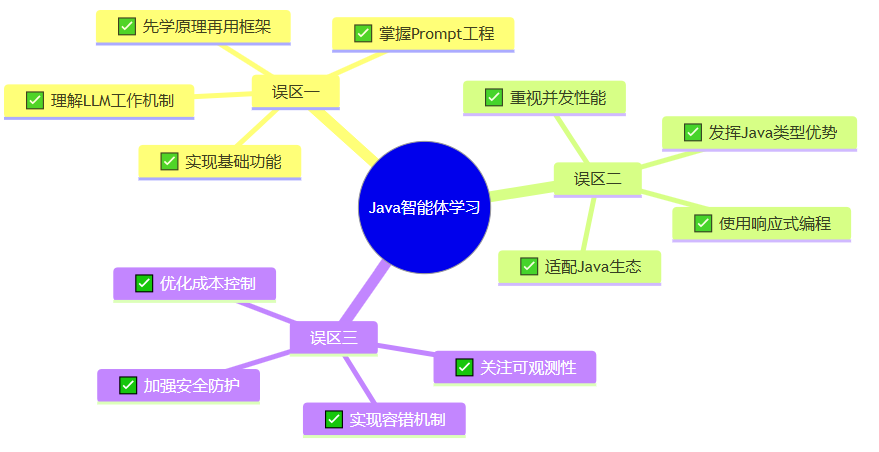
4.2 推荐学习资源
/**
 * 学习资源清单
 */
public class learningresources {

    public static class frameworks {
        // java agent框架
        string langchain4j = "https://docs.langchain4j.dev/";
        string springai = "https://spring.io/projects/spring-ai";
        string dashscope = "https://github.com/aliyun/dashscope-java-sdk";
    }

    public static class tools {
        // 开发工具
        string idea = "intellij idea + github copilot";
        string postman = "postman - api调试";
        string wireshark = "wireshark - 网络抓包";
    }

    public static class practice {
        // 实践平台
        string openai = "openai api文档";
        string huggingface = "hugging face模型库";
        string kaggle = "kaggle竞赛平台";
    }

    public static class reading {
        // 推荐阅读
        string[] books = {
            "《building agents with llms》",
            "《prompt engineering guide》",
            "《reactive programming in java》"
        };
    }
}
结语
java智能体开发是一项融合ai技术和java工程能力的综合性工作。避免这三大误区,按照科学的学习路径循序渐进,你一定能在java + ai的交叉领域找到自己的位置。
记住:先理解原理,再使用工具;先关注工程,再追求功能;先稳定可靠,再性能优化。
到此这篇关于java智能体ai agent开发中常见误区与避坑指南的文章就介绍到这了,更多相关java智能体ai agent开发内容请搜索代码网以前的文章或继续浏览下面的相关文章希望大家以后多多支持代码网!




发表评论