
 我要评论
我要评论背景
有这么一个需求:对以下的类型结果集进行更新。
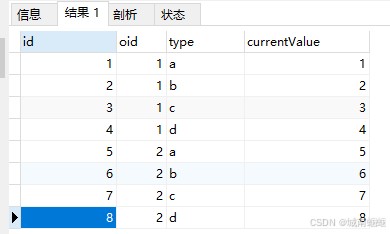
更新的原则是type为c的currentvalue的值= (type为b的currentvalue) / ((type为b的currentvalue) + (type为a的currentvalue)) *100。
上面这个需求有很多种实现方法,看到这个需求的时候,我想到的双重for循环:先查询第一个结果集,第一个结果集合里面包含oid字段。
然后对第一个结果集进行遍历,把oid作为参数更新到第二个sql语句中进行更新。
本文是用定义存储过程的方式实现对结果集的遍历,也就是我所希望的双重for循环。
工具:navicat。
数据:
drop table if exists `report_data`;
create table `report_data` (
  `id` int(255) not null,
    `oid` int(255) not null,
  `type` varchar(10)  not null,
  `currentvalue` double not null,
  primary key (`id`)
) engine=innodb default charset=utf8 collate=utf8_unicode_ci;
insert into `report_data` (`id`, `oid`, `type`, `currentvalue`) values (1, 1, 'a', 1);
insert into `report_data` (`id`, `oid`, `type`, `currentvalue`) values (2, 1, 'b', 2);
insert into `report_data` (`id`, `oid`, `type`, `currentvalue`) values (3, 1, 'c', 3);
insert into `report_data` (`id`, `oid`, `type`, `currentvalue`) values (4, 1, 'd', 4);
insert into `report_data` (`id`, `oid`, `type`, `currentvalue`) values (5, 2, 'a', 5);
insert into `report_data` (`id`, `oid`, `type`, `currentvalue`) values (6, 2, 'b', 6);
insert into `report_data` (`id`, `oid`, `type`, `currentvalue`) values (7, 2, 'c', 7);
insert into `report_data` (`id`, `oid`, `type`, `currentvalue`) values (8, 2, 'd', 8);
对查询结果进行遍历
先展示结果模板:
create procedure [存储过程名称()]
begin
        declare s int default 0;
    declare [变量名 1 ] int default 0;
    declare [变量名 2 ] varchar ( 255 );
    declare [游标名] cursor for [包含结果集的 sql ]
        declare continue handler for not found set s=1;
    open [游标名];
    fetch [游标名] into [变量名 1 ],[变量名 2 ];
    while s <> 1 do
        [你想操作的 sql语句 ]
    fetch [游标名] into [变量名 1 ],[变量名 2 ];
    end while;
close [游标名];
end;
说明:
(1).create procedure [存储过程名称()] 表示创建一个存储过程。我们这里假设名称叫processdata,那么这行代码就写成 create procedure processdata()
(2). begin 和 end 是函数的开始和结束
(3).
declare	[变量名 1 ] int default 0;
declare	[变量名 2 ] varchar ( 255 );
这两行代码是定义变量,为什么要定义变量呢,是因为我们查询出的结果集要放到变量中进行二次操作。
这里需要注意的是,变量名的命名规则除了跟普通变量一样以外,还不能够跟结果集中对应的字段名重复。
比如 select id,name from student;这个sql中有两个字段,id和name。那么定义变量的时候就不要再定义id和name了。可以换成idtemp 和nametemp。
另外,变量的类型要和查询结果集的字段类型对应。
declare s int default 0; 这行sql比较特别是定义循环变量s的,下面的while循环要用到。
(4).
declare [游标名] cursor for [包含结果集的 sql ]
这行sql就是定义游标,其中包含了我们的结果集,比如下面这样:
declare stu cursor for select id,name from student group by id;
这样的话,我们第一个结果集就出来了。后面就考虑遍历这个结果集。
(5).declare continue handler for not found set s=1; 声明当游标遍历完后将标志变量置成某个值
(6). open [游标名]; 这个不用过多解释,上面定义完游标后,这里打开游标。
(7).fetch [游标名] into [变量名 1 ],[变量名 2 ]; 这段sql是将我们查询的结果集与我们定义的变量进行关联,注意顺序应该一一对应。比如下面这样
fetch stu into idtemp,nametemp;
这里的idtemp就表示上面结果集中的id,nametemp就表示上面结果集中的nametemp
(8).
while s <> 1 do
....
end while;
这段代码是while循环。
(9).
[你想操作的sql语句]
这个地方就是内部for循环了,比如我们在这个地方写一个update语句。
update student set score='91' where id=idtemp and name = nametemp;
这个语句就会去寻找上方结果集中的id和name,然后把值代入到idtemp中和nametemp中,进行操作。
(10).
fetch [游标名] into [变量名 1 ],[变量名 2 ];
这段表示将游标中的值再赋值给变量,供下次循环使用。
当定义完了以后,执行sql。然后就是navicat的函数,找个我们刚才定义的函数进行执行。
完成需求
上面已经说明白了整个过程的含义,下面我们来完成本文的需求。
create procedure processdata()
begin
declare s int default 0;
declare oidtemp int default 20;
declare report cursor for  select oid from report_data  group by oid;
declare continue handler for not found set s=1;
    open report;
    fetch report into oidtemp;
    while s<>1 do
            set @fenzi=   (select currentvalue from report_data where type='b' and oid =oidtemp);
      set @fenmu=   (select currentvalue from report_data where type='a' and oid =oidtemp) +
                                    (select currentvalue from report_data where type='b' and oid =oidtemp);
            set  @result =  @fenzi/@fenmu *100;

            update report_data set currentvalue = @result where oid =oidtemp and type='c';
        fetch report into  oidtemp;
    end while;
    close report;
end;
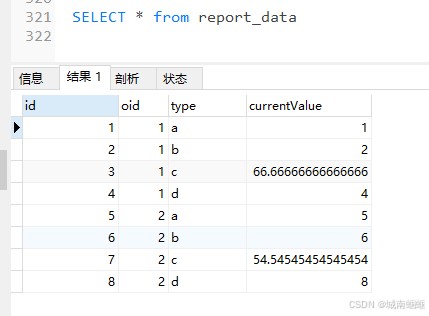
结果
总结
以上为个人经验,希望能给大家一个参考,也希望大家多多支持代码网。






发表评论